Information Science major Francis Ametewee developed a campus navigation platform with guidance from Computing Catalyst’s TechStart program.

When Francis Ametewee arrived at the University of Maryland, finding his classrooms often meant deciphering building abbreviations before he knew where to go. After repeated searches and requests for directions, he had an idea: build a campus guide that starts with what students already know.
Ametewee, a junior majoring in information science in UMD’s College of Information, developed TerpNav, a free website that helps people find campus buildings and understand parking restrictions. As he worked to improve the platform, he participated in TechStart, a summer program taught by UMD Lecturer of Computer Science Elias Gonzalez and offered through Computing Catalyst. The program introduces students to coding, design thinking and technology development through hands-on projects and mentorship.
For Ametewee, the opportunity to work alongside students with different backgrounds and experience levels was an important part of the program.
“TechStart was beginner-friendly as well as expanded on concepts for advanced people,” Ametewee said. “You can always still learn and continue to learn with others and from staff alike, which I really appreciated.”
Games to Maps
Ametewee’s path to developing TerpNav began years before he participated in TechStart. His interest in software started with video games, eventually leading him to create his own Roblox game and explore programming beyond entertainment.
“I was really intrigued with computer science through video games,” Ametewee said. “It later led me on to wanting to solve problems with code.”
That interest eventually shifted toward developing applications that address everyday challenges. At UMD, he encountered two problems he wanted to address: finding campus buildings and understanding parking restrictions.
After exploring an existing university mapping service, Ametewee decided to develop his own platform, focusing on searchable locations, parking information and a simplified interface.
“I wanted to offer simplicity and modernity,” he said, describing his approach to designing a platform where users could find information without navigating multiple resources.
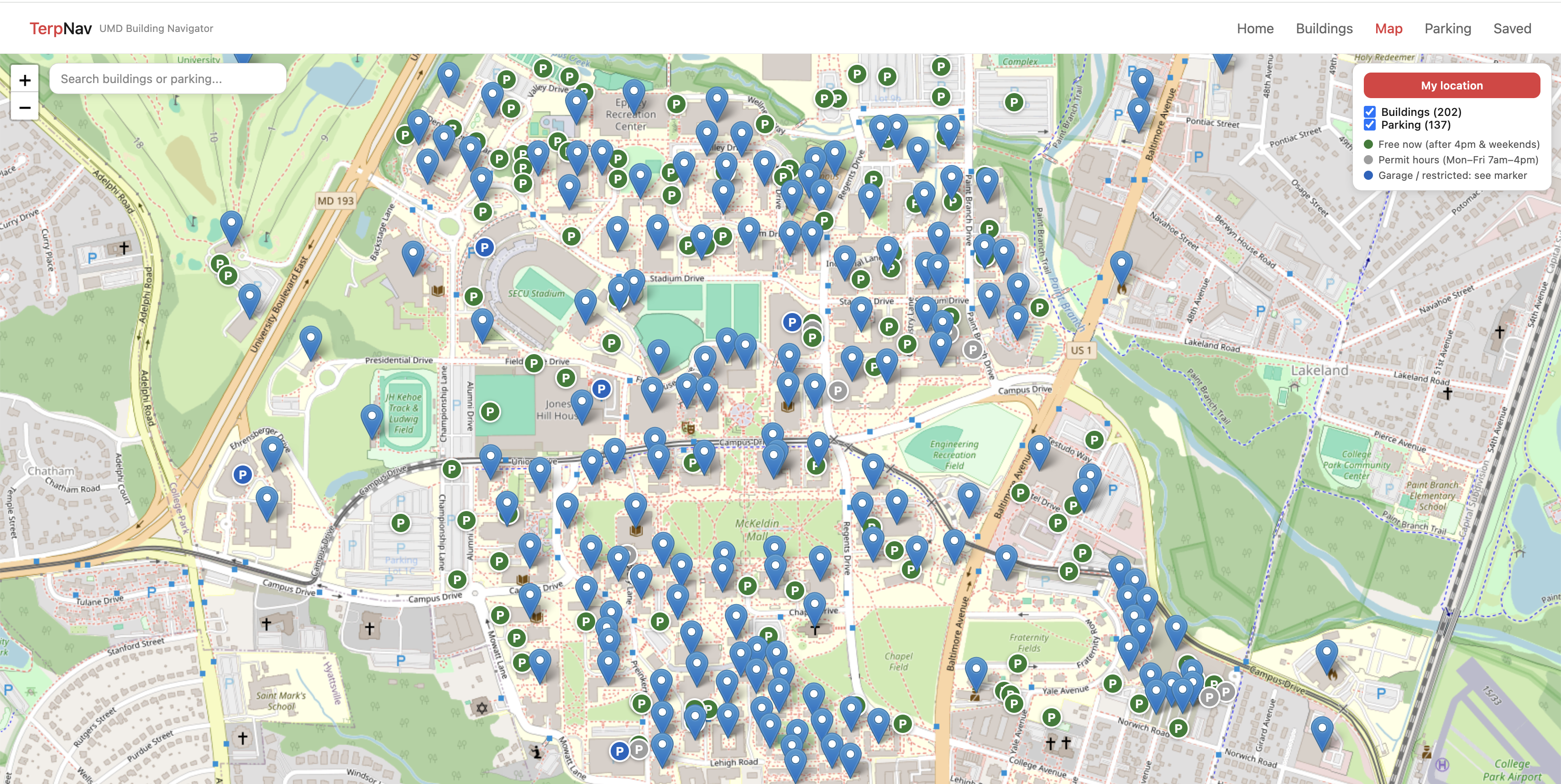
The website lists more than 120 buildings and 137 parking lots. Users can search by building abbreviations, names or departments, explore locations on a map and save frequently visited places. TerpNav also identifies parking lots that are free to use at particular times under UMD Department of Transportation Services rules, although it does not track whether individual spaces are occupied.
Ametewee developed the platform independently, using React 19 for the user interface, Django REST Framework for application services and PostgreSQL for data storage. The website draws information from several public data sources, including Maryland geographic information systems, the umd.io API, OpenStreetMap and Wikimedia Commons.
Mentorship in Action
By the time Ametewee joined TechStart in summer 2026, TerpNav was already under development. The program gave him an opportunity to examine the platform from a user's perspective and identify features that could improve its functionality.
Through the program, Ametewee received guidance on refining his platform’s features and gathering feedback. TechStart pairs student projects with industry mentors who meet with participants throughout the week to discuss ideas and offer guidance. Ametewee's mentor, Samuel Mensah, a project manager at HBO Max, helped him identify improvements and consider ways to expand the platform's reach.
Working with Mensah, Ametewee reviewed several vital aspects of the website.
“I didn't have filtering at the top of TerpNav, so that was one of the features I had overlooked,” Ametewee said. His mentor also recommended adding filtering options to the map and revisiting its visual elements.
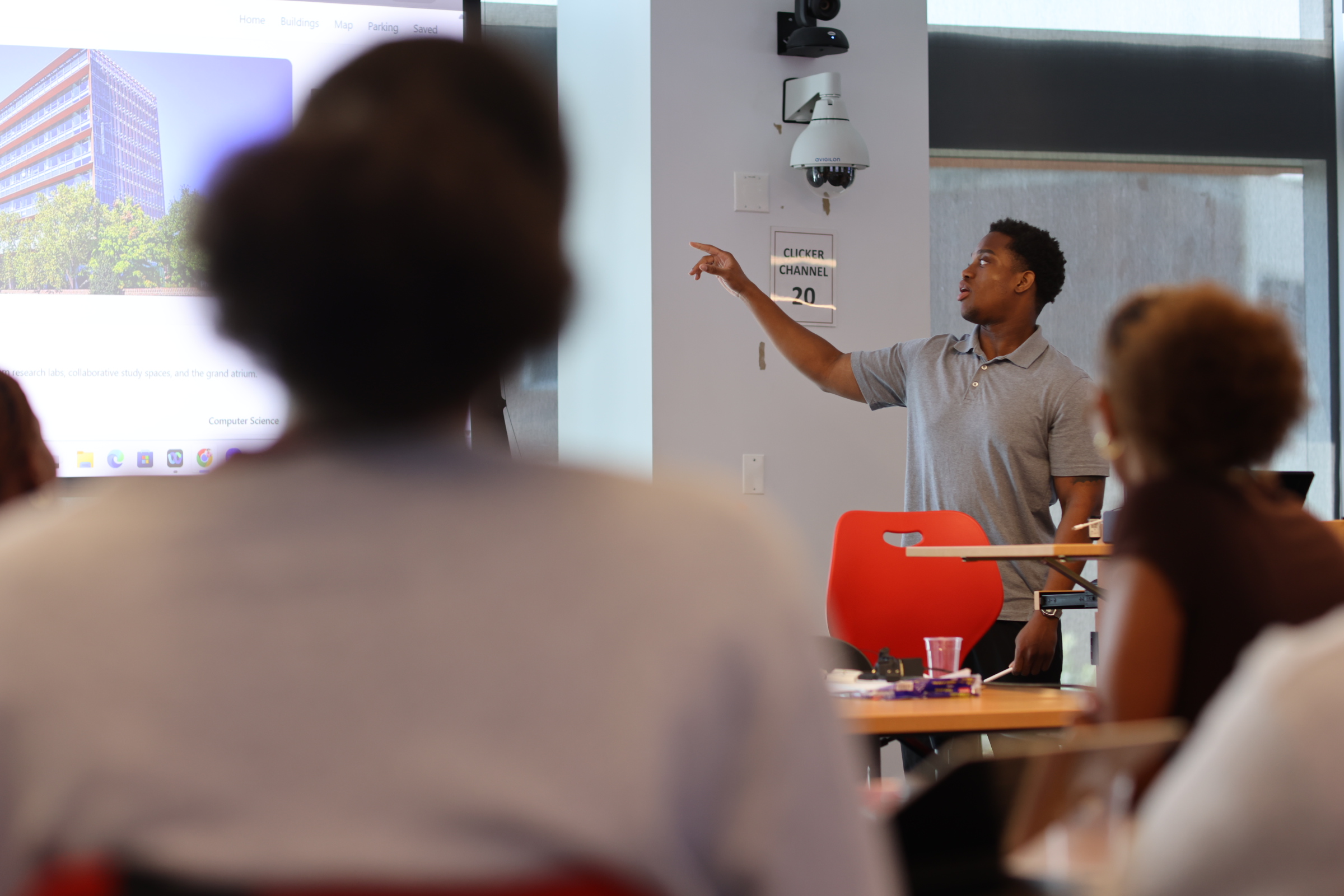
Acting on his mentor's advice to gather user feedback, Ametewee launched a survey for students and staff, offering participants entry into an Amazon raffle. The responses offered additional suggestions for features and improvements he hadn't initially considered.
“The ideas that I have or the problems that I have may not be problems that others have,” he said.
During its first month online, TerpNav recorded 740 visitors and 2,279 page views, according to Ametewee. Much of the traffic came from UMD’s Reddit community, where users also shared feedback.
“I wasn’t even expecting over 100,” he said of the visitor count. The response encouraged him to continue developing the platform, which he maintains independently while covering its database costs.
Beyond College Park
Ametewee is now an Accelerator Fellow with UMD’s Do Good Institute, where he is working on the next phase of TerpNav. His immediate plans include incorporating user feedback and adapting the platform for Towson University.
He eventually hopes to expand to other Maryland campuses, including Howard, Morgan State and Bowie State, before developing a navigation service for universities nationwide.
As he looks toward expanding TerpNav to other campuses, Ametewee recognizes that improving the platform will require continued testing, feedback and revisions. Seeing students use something he developed has encouraged him to pursue new ideas and consider how technology can address everyday challenges.
“Developing something takes a lot of time and iterations, but seeing people actually use what I’ve built motivates me to keep going,” Ametewee said. “I want to continue improving TerpNav, expand it to other places and keep developing solutions that make everyday life easier for people.”